
.jpg)
I-35 Parkland Project Faces New Challenge

You may have heard that Mayor Watson has proposed a new, scaled-back proposal regarding the I-35 Cap and Stitch project. (See recent KVUE and KXAN stories). If it passes city council on May 28, it would counter the council’s May 2025 $104 million commitment to fund the foundational roadway elements for six "caps" and two "stitches" over Interstate 35 as part of TxDOT’s major expansion project, currently underway and expected to be completed by 2033.
The 2026 ATXelerator cohort, which concluded its program on May 17, has taken a deep interest in this issue and is organizing to advocate for ensuring that council remain committed to funding the structural elements. If they are not built in TxDOT’s first phase of the highway expansion, then it’ll be too late in the future to ever go back and build the structural elements.
The mayor’s proposal, with the backing of Council Members Laine, Duchen and Siegel, would utilitze a $41 million state of Texas loan to build a small cap from Palm Park across I-35. His proposal also contemplates a potential covering between 11th and 12th streets although it is not included in this iteration. However, this would be a drastically reduced project which, as currently designed, has the potential to create a transformational link between the long-divided downtown and east Austin neighborhoods. Council Members Alter, Harper-Madison, Qadri, Vela and Velásquez are on record opposing the mayor’s proposal, and still support the full cap-and-stitch project.

A rendering showing a promenade at Third Street as part of the Cesar Chavez Street to Fourth Street cap over I-35
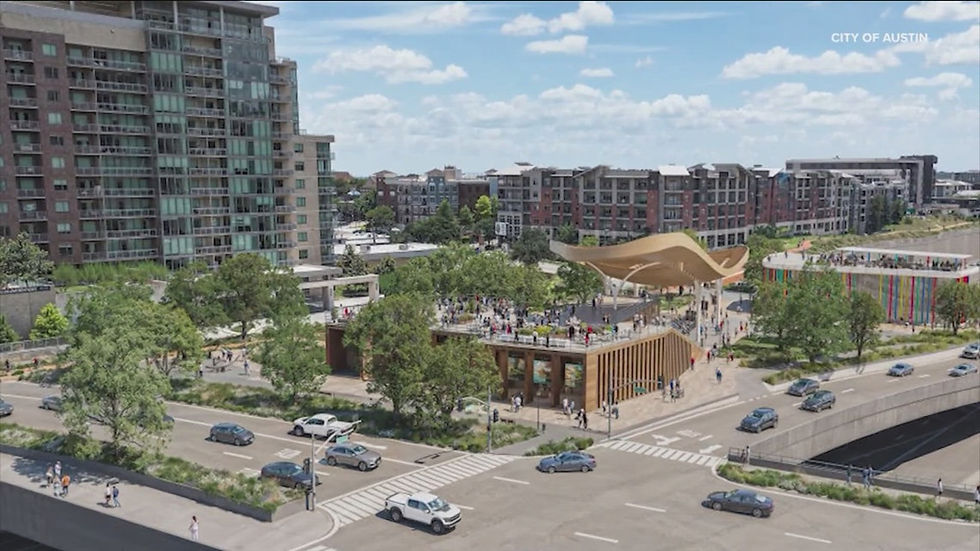
Rendering of a cap between 11th Street and 12th Street
The Downtown Austin Alliance (DAA) is the main organization advocating for the council to stick to its $104 structural element commitment. In support of the DAA and the cap-and-stitch project in general (a textbook future-focused policy issue), the 2026 ATXelerator class is organizing an email campaign directed at city council and recruiting speakers to sign up to speak at the 10 am May 28 Austin City Council meeting.
If you would like to communicate with city council on the issue, click here to land on a page where one email goes to all council members and the mayor. Click here for information on how to sign up to speak virtually or in person on a city council agenda item. In person is always more effective.
Some recent background on the project.
In May 2025, the city council made a wise commitment to fund the building blocks of the I-35 cap-and-stitch project. While it will take time to properly fundraise from state, federal and philanthropic sources to complete the caps and stitches, that effort is a Phase 2 endeavor. Funding and creating the structural underpinnings is a once-in-a-lifetime opportunity to form the basis of a generational transformation of the city’s core, uniting east and west Austin and further adding to Austin’s reputation as a world-class city.
Mayor Watson has historically been a visionary leader for the region as a four-term mayor and four-term state senator. As examples, he secured a $100 million agreement to reserve Colorado River raw water for Austin through at least 2050 and championed the placement of the UT Dell Medical School in Austin.
While understandably sensitive to the city’s challenging financial condition, Mayor Watson’s downsized stitch/cap proposal significantly minimizes the generational opportunity to transform I-35 in central Austin. The proposal is smaller than Republic Square and with it spanning the highway, it would lose the pedestrian experience and selling point of what a true cap provides. In short, it would serve more as a pedestrian bridge, which is a far different proposition for fundraising than a vibrant development on a cap.
The full Cesar Chavez-to-4th-Street cap should remain the primary focus, and we believe it provides the greatest possible return on investment, especially with the new Austin Convention Center coming on board and the adjacent Waterloo Greenway coming to fruition.
TxDOT is requiring setbacks (from the edges) due to loading capacity. While we don’t yet fully know the setback length, this restriction makes it more difficult to place trees that don’t impede pedestrian flow. With the limited size of the mayor’s proposed stitch/cap, this is a design concern that would affect fundraising.
If constructed, the 6th Street cap will serve as a major economic benefit in a later development phase. Considering the ongoing investment in E. 6th street, this future cap has the potential to connect E. 6th with the vibrant restaurant-bar nightlife east of I-35. However, the mayor’s proposal does not include future-proofing this cap location.
Losing the $105 million grant from the federal government for the Cesar Chavez through 4th St cap last August was painful. For the time being, it has clearly set the entire project back. But what was lost may be found again. Highway caps are increasingly popular across the country - and have been impressively successful in many places.
The political environment could change substantially in November 2026 and grants that were cut by this Congress could be restored by the next Congress or by a future administration in 2028. This was the main reason to future-proof the highway redevelopment because the whims of Washington D.C are fickle and come-and-go with greater frequency.
There will be future opportunities to cap the highway, but only if the road supports are built now. What’s buried simply can’t be redone.
In my 45 years of living in this great city, I can think of no other infrastructure project, except Project Connect, that would have such a long, lasting and transformative impact on this city and region. This is something we owe our children and grandchildren.
When opportunity knocks, answer it.


A scaled-back proposal is better than nothing, but I hope the city doesn’t lose sight of the original vision for reconnecting our neighborhoods. Curious how this affects the timeline for the full project, I’ve been following the details on https://hunyuan3d.dev
A scaled-back proposal is better than nothing, but I hope the city doesn’t lose sight of the long-term connectivity goals that made the original Cap and Stitch plan so compelling in the first place. Curious how the revised timeline affects the neighborhood businesses that were counting on the full build-out—I’ve been following the updates closely v https://vo3-ai.net
The scaled-back proposal feels like a step in the right direction, but I’m worried the reduced scope might leave the cap too narrow to actually reconnect the neighborhoods. Curious how the funding gap shifts with this new design—checking the full breakdown over at https://samaudiolab.com
The scaled-back proposal feels like a step in the right direction, but I’m worried the reduced scope might leave the cap too narrow to actually reconnect the neighborhoods. Curious how the funding gap shakes out for the remaining phases—I’ve been tracking the latest updates on https://hy-3d.com
Trump threatens 82 lottery new tariffs on European allies over Greenland until deal reached, as thousands protest...